Sermon by Rev Sydney Maitland for Sunday 24 July 2022.
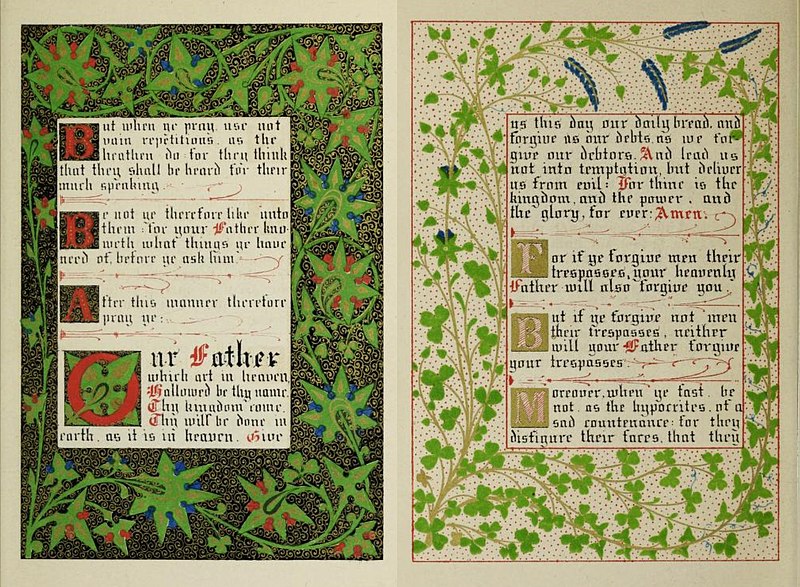
Lord’s Prayer from the 1845 illuminated book of The Sermon on the Mount, designed by Owen Jones. (Source)
• First Reading: Hosea 1: 2-10 (The coming unity of Israel and Judah; the coming leader)
• Psalm 85
• Epistle: Colossians 2: 6-19 (Continue your lives in Christ – let no one take you captive through hollow and deceptive theology)
• Gospel: Luke 11: 1-13 (The Lord’s Prayer – persistence in praying)
I cannot remember where this nugget comes from but it has been said that we can sustain about 100 active relationships at any one time. It is not that I have tried counting them lately, and of course there are many people whom we have known and have lost touch with, but the number of people we actively know seems to stabilize at around 100.
And that means the people that we talk to, whom we see with any regularity, whom we contact by phone or email or whatever.
And the important thing about these contacts is that we can and do share with them some part of ourselves. We speak of what we are doing, our health and our interests and yes, our opinions. We can tell them and ask them things, share news and jokes, and of course the reverses of life.
And so when it comes to God we have another kind of relationship, but it is still one in which we both speak and listen. We look for the things that please Him and we try to avoid the things that displease or anger Him.
And this is the context in which Jesus’ disciples wanted to know about prayer – speaking to God. John the Baptist had taught his disciples about prayer. So what was Jesus going to say? How would He teach them?
And Jesus kept it very short and simple. In praying to God, it is God that is the starting point, and not ourselves, no matter what our needs and concerns are.
He starts with worship – putting God in His proper place as Lord of all and them putting ourselves in a proper relationship with Him.
So God is addressed as Father – one who seeks our best interests and knows and sees far more than we can ever imagine or expect.
And yet His is also in Heaven, far about the earth and yet is a God to be prayed to and not one to be persuaded or appeased by extravagant sacrifices or rituals.
It is only half-way through the prayer that Jesus comes to our own needs – and these too are kept very simple. The Daily Bread might I think, include sufficient water, clothing and protection. But Daily Bread says enough.
And the meeting of personal physical needs is followed by immediately by our relational needs: forgiveness of our sins in the measure that we forgive others.
God is not normally known or worshipped in isolation and even isolated communities have a common life, even when the stress is on personal seclusion.
And in the strength of this we pray not to be led into or exposed to temptation which we cannot resist.
All of this is the expression of our deepest relationship in life – with God in Jesus Christ.
But Jesus goes further with two more points:
First, never give up. Some prayers are answered immediately or almost so. These are the ‘Ask and you will receive’ prayers.
But then there are the prayers that involve seeking – searching out, pondering, waiting, and doing so fully trusting in the provision of God. We love Him and He loves us, but some things may require us to be prepared to receive the answer. There may be some things that we are not yet ready for, and in the love of God we may have to wait.
And then there are the prayers in which Jesus strangely tells us to knock for there will be an answer. The heavens may seem to be closed and have a leaden lid on them as we wait and wait, but even this waiting is a time of attentiveness and expectation.
It is a waiting founded on love. A love that trusts and does not despair. A love that does not throw tantrums when what is sought does not transpire immediately. It is a love that is content to abide, wholly confident in the fulness of the love and super-abundant provision of God.
The prophet Habakkuk said something about this:
‘Though the fig tree may not blossom, Nor fruit be on the vines; Though the labour of the olive may fail, and the fields yield no food; though the flock may be cut off from the fold and there be no herd in the stalls – YET I WILL REJOICE IN THE LORD, I WILL JOY IN THE GOD OF MY SALVATION.’ (3: 17-18)
Our prayers are the outpourings of the heart – they may be short and desperate – sometimes called ‘Arrow prayers’. They may be the needs of the moment, or they may be the reflections of times of joy or of stress.
But God is never deaf or blind. And it is not as if we are telling Him anything He does not already know: rather, we are placing ourselves in His hands so that He may meet us and feed us and fulfil us. He never answers prayers with things to harm us.
Anyone here who is a parent knows that there are times when relations with children are deepened when they come to us with a need we have already seen – and equally, will feel that rejection when a need is clear enough but is never entrusted to that parental love and care.
And that is why God looks for our prayers. Prayers – not treatises on theology.
And He never gives stone when bread is asked for, or a snake instead of a fish, or a scorpion instead of an egg. Not even human parents would do this.
