Sermon by Rev Sydney Maitland for Sunday 16 July 2023.
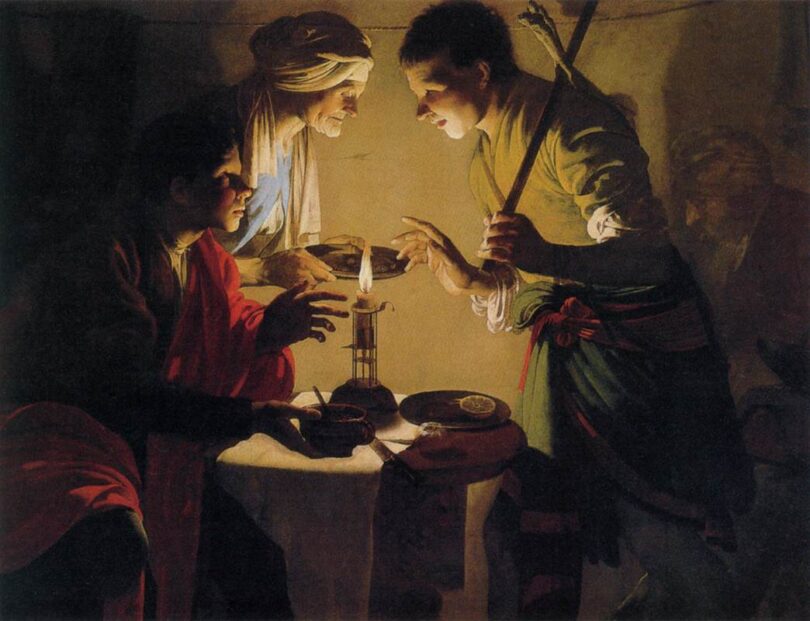
Hendrick ter Brugghen, Esau Selling His Birthright, c. 1627 (Source)
• First Reading: Genesis 25: 19-34 (Esau and Jacob: Esau sells his birthright to Jacob for a plate of stew)
• Epistle: Romans 8: 1-11 (No condemnation for those who are in Christ Jesus)
• Gospel: Matthew 13: 1-9, 18-23 (Parable of the Sower)
I suppose that the kind of things that we value tell of the kind of people we are. For some, it is the principle of overwhelming force that matters and the ability to master or at least intimidate others.
For others, the gathering of wealth and possessions. And yet for others, the satisfaction of personal wants and desires.
Then there is intellectual and moral curiosity, the use of the arts to express ourselves and our aspirations. They can also criticize and ridicule the times, the customs and institutions of the day.
For some it is order and predictability while for others it is variety and the combination of shape, form, colour and texture.
For Esau, it was the hunt. The bringing home of game that he had tracked and killed, the fruit of his own labour and skill. Not too much time for social finery or cultural refinement. Not interested in legal argument or distinctions, let alone procedures.
That was all for the wets and the mummy’s boys of the world, people like his brother Jacob. For Esau, Isaac was a man’s man.
And so when he came in from the hunt, unsuccessful this time, but hungry and dispirited, there was his dear brother doing women’s work: in the kitchen, where he belonged.
But my, that stew smelt good. Thick and rich and he was ready for some. In fact he was ready for a lot of it – possibly all of it. The obstacle however was the chef of the said stew – and he was not for giving it away. So offer any price, just get the food. Any deal could and would be repudiated anyway.
Birthright? Just what is that anyway? Does it hunt and kill, does it build and form? No matter, if that was the price, then Esau would pay it.
And he did – to the end of his days.
Now to change the subject there is Paul’s letter to the church in Rome: a church dating back to that Day of Pentecost when the spirit came.
This was not a church founded by Paul on one of his journeys and so he wrote at length, setting out his view of the Christian message and hope within a culture of Roman might and law.
This was a time of fine laws and buildings, the greatest army in the world, of culture and music and writing.
It was also a time of crude power plays, everyone hoping to catch the eye of a wealthy trader, a senator or even Caesar himself.
Definitely a time of survival of the fittest and let the weakest step aside and take orders from others.
And yet for Paul the issues were even more profound than that. It was far more than the blood lust of the games. It was the kind of people that humanity had become. That tendency to promote self and to tread on the weakest. That demand for the fulfilment of all desires that the self could contrive, all the appetites and all the intoxications of power.
This was a time when the Christians offered – well, what? A sapping of the will to fight and strive? A carping criticism of the delights of the games and of the orgies of the time? A sympathy for the outcasts and the slaves of society – the losers of the world?
And so Paul set out his message. The moral and spiritual state of the world, its moral degeneracy and how it stood opposed to the things of God and would in time be judged and found wanting.
The illusion that by performing some perfunctory acts of charity then the soul would be delivered from any real accountability when the days on the earth were completed.
No. This was a time of abject need before God and of utter moral corruption. The various fashionable sexual vices were only the proof of it – the poisoned fruit of a corrupt tree.
The only hope and help would be God’s intervention in Jesus Christ in which God would take the initiative for the whole of humanity. He would confront corrupt justice and the powers of death. Jesus would be raised from the dead. There would no longer be any room for argument.
And so Jesus’ parable of the seed and the soils is directly relevant. The seed would be offered to all, and they would receive it as best they could.
Some would be responsive and fruitful – others interested until other distractions intervened or the times turned against them. Others would have an Esau-like contempt.
But Paul says something more about the new life in Christ Jesus. It is about a new beginning and a new birth. The gospel was not going to be force-fitted into the hostile culture of the day. It would be a counter culture, with new aims and principles.
To receive Jesus as He comes is to receive the whole purposes of God. Life is changed and eternity has utterly new dimensions.
There is no question of accommodating the times and the manners of the age – and this is not only a change of mind but a change of person.
It is a new life in which the initiative passes to God. His life, His holiness, His justice and His mercy.
His fruit, His soil, His trees and gardens. But Jesus is the vine and His Father is the gardener, looking for fruit and pruning the branches so as to improve the yield.
