Sermon by Rev Sydney Maitland for Sunday 9 June 2024.
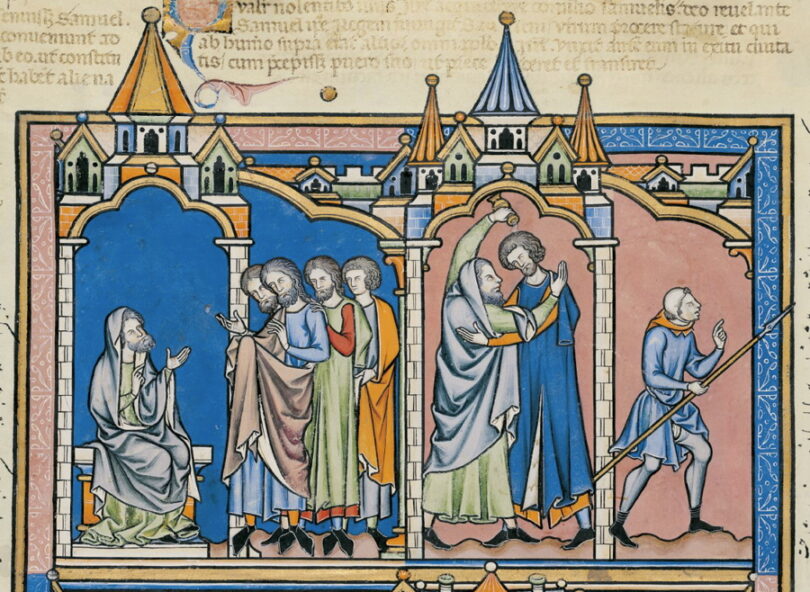
Samuel and the elders; the Morgan Picture Bible, c. 1250 (Source)
• First Reading: 1 Samuel 8: 4-20 (They ask for a king, such as other nations have. Samuel warns them of what a king would claim)
• Epistle: 2 Corinthians 4: 13 – 5: 1 (The One who raised Jesus from the dead will also raise us with Jesus)
• Gospel: Mark 3: 20-35 (Whoever does God’s will is My brother and sister and mother)
One of the most insidious and crushing pressures we know is the pressure to conform. To fit in, not stick out or attract the wrong sort of attention.
It is the pressure to give unconditional approval to the latest fashion in ideas, or forms of entertainment, of political or even sporting loyalties. It does not ask questions or raise doubts, but goes along with whatever is being promoted.
They call it ‘groupthink’ and it can apply to any organization, whether this is social or at work. It can be cultural or even religious. And it is there in some of our worst mishaps when organizations get things badly wrong.
And yet they came to Samuel, with the plausible explanation that as he was getting on in years and had no obvious successor the Israel should be led by a king, like the other nations.
And God said that they could have a king if they really wanted one – but they were really turning against the leadership He had given them in the judges of Israel.
So: you want to be taxed, conscripted, have your property requisitioned, and led into who knows what stupid adventures – OK you can have a king. But you will probably – certainly – come to regret it.
But then the groupthink could also become dangerous, even for Jesus.
They refused to acknowledge His ministry, and despite all the evidence to the contrary, they put His miracles down to the powers of evil.
There was not a shred of evidence of this in His life or teaching, and His miracles were all about restoring and releasing people into health and new purposes in life, but the explanation to rationalize this rejection was that Jesus was an agent of Satan. This was more an early conspiracy theory.
They saw the evidence but were determined to twist it into something else. They were rejecting not only Jesus and His ministry but their own salvation that would come through it.
Their own standing and privileges demanded this perverse argument, and so they pursued it. The more that they insisted on it, the more it became part of them, and the more they entertained it then the more it held them.
So yes, they ended up rejecting their own salvation.
Not all of them – some, like Nicodemus were more open-minded and set out to find out for themselves.
But Jesus saw something else, something more. A house – or a nation divided like this was weakened and vulnerable. It was brittle, and under pressure would crack, maybe even collapse.
For there was another way of seeing things. There were also those who acknowledged what Jesus was doing and who He was. Their agenda started with God, and this provided the base for their thinking.
If they started with God and stayed with God then their lives would be filled with the things of God. They would look for His ways of doing things and His wisdom to illuminate their own thinking.
These were the people who could hear what Jesus was saying – and understand it. They would see His actions and perceive within them the purposes of God. Above all they would want their own lives to follow this pattern and not another.
And these were the people to whom Jesus’ own heart was reaching out. They were His kin in the spirit. They were the people whom God had given Him and to whom and for whom Jesus would give Himself, utterly and totally.
More than the poor of the land these were the people of His own heart.
And this story comes near the beginning of Mark’s gospel, which is thought to be the first gospel to be written.
But it is repeated in Matthew and Luke. It is there in John, where in the High Priestly Prayer, Jesus commits Himself to those who belong to Him. It runs through the Gospels and letters like a vein of gold in rock.
It is also there as just before His passion, Jesus instructs His disciples to love one another in the same measure that He had loved them. After His resurrection, when He commissioned them to spread the gospel with the same commission that He had received from His Father. Nothing less.
It is the same total and intimate sense of asserting that those whose lives were committed to Him were also one with who and what Jesus was. They were His and He would never let them go.
Now that sense of spiritual kinship with Jesus, was a bond of love – and a love that extends for all eternity. It is a kind of identity and purpose that endures all insults and reverses, all setbacks and failures.
Those who follow the purposes of God in their lives are also those to whom He has dedicated His life – a crucified but also a resurrected, ascended and glorified life as well. In this they may be filled with His Spirit and strengthened and renewed for His commission in life.
And this is a promise that comes near the beginning of the first gospel to be written. Its currency is forever, in the glory of His kingdom.
