Sermon by Rev Sydney Maitland for Sunday 18 August 2024.
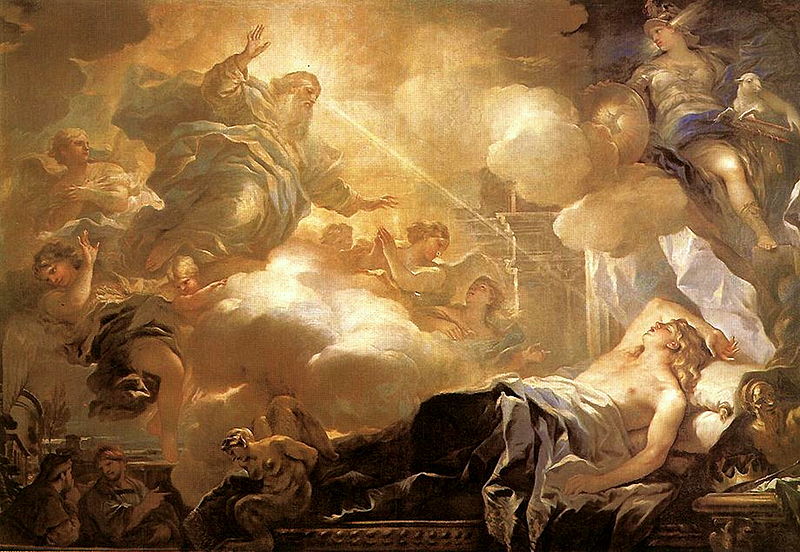
Luca Giordano, Dream of Solomon (at Gibeon), c. 1694-1695, Museo del Prado (Source)
• First Reading: 1 Kings 2: 10-12; 3: 3-14 (Solomon went to Gibeon to offer sacrifices. ‘What shall I give you?’ ‘Wisdom.’)
• Epistle: Ephesians 5: 15-20 (Be filled with the Spirit … always giving thanks to God for everything in the name of our Lord Jesus Christ)
• Gospel: John 6: 51-58 (Whoever eats My flesh and drinks My blood remains in Me, and I in them)
Have you noticed how much public life depends on appearances and feelings?
It always seems to turn on what something looks and feels like. It is the appearance, and hence the presentation that matters more than the content or character.
Look at any recent campaign on almost any issue – and then ask how much was based on appearances and presentation, and how much on content and the credibility and reliability of what is proposed?
Look at the presenters. Good looking? Plausible? Decently dressed and turned out? Never mind the content, look at the promoter.
And then look at our advertising. How much of that is about appearance and image – and the way the product is presented to the target group. Belittle someone in order to make the item more appealing and desirable? Trade on resentments and frustrations?
Yes, more and more is about feeling and appearance, less and less about content.
But then look at King Solomon, stepping into the big shoes of King David. Born to a mother who was joined with David in a pre-marital scandal, and not the eldest son anyway. Not exactly the war leader by the look of him.
He went to Gibeon, which had made a treaty with Joshua, but was not an Israelite city and where its people had to live by their wits. And this was where in a dream, God had said to Solomon ‘What can I do for you?’ and Solomon had asked for wisdom: a discerning heart to govern the people and distinguish right from wrong.
He wanted to govern rightly and to discern not only the will of God but the motives of those who came before him.
And this simple request brought joy into the heart of the Lord for this king really would listen to what the Lord had to say and he really would think about it – and do it.
So the Lord promised him a wise and discerning heart – and with that he would also be able to handle wealth and honour, while discerning fraud and flattery. So long as Solomon stayed true to the Lord then these things would indeed be his.
Speaking to the people Jesus also presented them with a paradox. Moses had fed them with manna in the wilderness but Jesus would give them the bread of life.
He would give them Himself – and they would draw upon Him as they came together to worship. He would be the Bread of Life, received in the celebration of the Lord’s Supper or Communion but also received in His own word:
‘Man shall not live by bread alone but by every word that comes from the mouth of God.’
They would learn to love the Lord with their hearts and minds, and to discern His word from the constant babble of opinion and broadcast media. The ear would hear but the heart would discern. The ear might be assaulted but the heart would establish a space for pondering and reflecting, waiting and weighing up.
Was this or that proposition or appeal or campaign true – did it resonate with the Spirit of the Lord or was it all a show, put on to attract attention but otherwise empty of content?
Making undeliverable promises but demanding unquestioning obedience? Were people being swept along in a wave of enthusiasm, with great razzamatazz but no foundation and no reasoning?
What Jesus promises is His personal presence as the disciples worshipped and reflected. As they sought His face so the Holy Spirit would guide them: leading always with His words and actions and never apart from them.
And so, writing to the Ephesians, Paul also called the church to wisdom and not folly. They should seek to understand what the Lord’s will was in their relationships and transactions, their loyalties and interactions with the community.
Theirs was to be a life filled with the Spirit: a community life like none other. Freely worshipping and joyful in the Lord, regardless of opposition in the city.
It would mean a set of priorities and perspectives derived from their faith and their life as a church, even when beset by the pressures to conform to the Diana fertility cult of the city.
They were to find these things in the details of daily life, perhaps not rushing headlong into the latest craze or fashion or gossip.
And these issues have not gone away. They are still with us, as we also need that wisdom to discern the will of God in the things of daily life.
We also – maybe more than many – are now beset by the intrusiveness of media and fashion, the pressures to conform and to accept prevailing attitudes which may draw us from the faith that supports us and in which we live.
Maybe might is not always right and maybe it is the frailest in faith on whom the Lord’s favour rests.
Maybe there is forgiveness and reconciliation where others prefer to condemn.
May we also live by every word that comes from the mouth of God and not from our own emotions.

