Sermon by Rev Sydney Maitland for Sunday 27 March 2022.
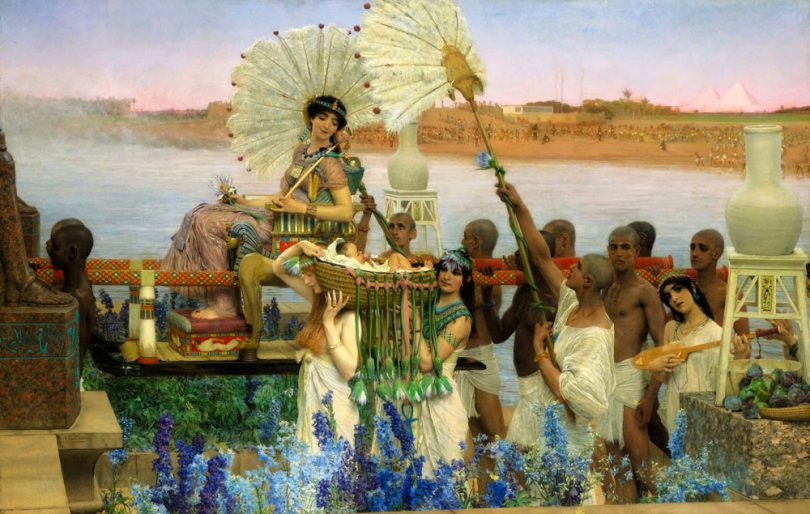
The Finding of Moses, painting by Sir Lawrence Alma-Tadema, 1904 (Source)
• First Reading: Exodus 2: 1-10 (Birth of Moses – hidden in a basked in the river)
• Psalm 107: 1-3, 17-22
• Epistle: 2 Corinthians 1: 3 – 7 (God’s comfort to us in our troubles, which helps us to comfort others who are also distressed)
• Gospel: John 19: 25b-27 (Jesus commends His mother to John)
Most of today’s heroes are sporting or wartime achievers, together with those who have excelled in the arts or business.
These are the people who are remembered with awards, pictures and statues; streets and buildings are named after them and they are the role models for society.
Yet over the last couple of years we have been looking at heroes of a different kind: the carers, the doctors, nurses, ambulance drivers and those involved with the care and treatment of victims of the coronavirus.
These are the people who were engaged with the ongoing care of the people whose conditions were or could become urgent, possibly fatal, and where there were real risks in catching the virus themselves.
There will be some awards and recognition but much of the work of caring has been going on unseen and unheralded. Yet lives were saved and grief avoided by this work of continuing care and attention.
It may not be the stuff of heroic and dramatic events but then it was the stuff of self-giving service, sustained over years.
It may match the work of those who in Ukraine have been busy rescuing people from the ruins of buildings, caring for them, feeding and tending to them and possibly helping them to escape to safer locations.
This is the context in which we see today’s lessons.
In Exodus, we see the heart-wrenching story of how, in order to protect Moses, his mother had had to abandon him to the waters of the Nile. She had to let go at a time when he needed her most and this act of sacrifice is recorded but not really developed. The facts had to speak for themselves and any mother who has had to let go of a child, at any stage of life, will understand this.
And even when given the task of looking after Moses for the daughter of Pharaoh, she could still not really claim any kind of motherhood. This was a deep and costly sacrifice.
In the gospel, we are given the account of how, on the cross, Jesus was making final provision for His mother.
Ever since that wedding in Cana, Mary had been letting go of Jesus and now it had come to this. Jesus’ earthly life was closing and whatever came after would be different.
This was the third word He had spoken from the cross, and Jesus’ thoughts were becoming more and more intimate.
First, He had forgiven His executioners. Then He had assured the penitent thief of his place in Paradise. Now Jesus was looking for the care of His Mother.
And Jesus entrusted her to the care of John, the beloved disciple who would indeed honour and look after her as he would his own mother.
Jesus had complete confidence in John, and no doubt in the days and years coming John would have been telling Mary what was going on in the church and the day’s events as he and Peter wound up the authorities by preaching the gospel.
Every day with John was also a day with Jesus even though Mary had seen His resurrection and ascension and had been there on the Day of Pentecost when all heaven was let loose on the church.
In this Jesus had been confiding His mother to the care not just of the church as a living body but to the one disciple with whom He felt most comfortable.
After this word of entrusting Mary to John, Jesus’ thoughts turned inward: His sense of abandonment by God, His personal thirst as He hung there dying, and His confidence that the task entrusted to Him by God was complete.
It is the epistle however which makes the whole matter of caring personal and intimate. It is a picture of a personal faith that works, especially when it has been tried by events.
It is a faith that has learned the hard way how to deal with the adverse things of life and which has learned how to lean on God.
This is the faith that refuses to yield, either to the trials of the day or to doubt and self-pity.
It is a faith that has learned how to hang on for as long as it takes. It continues to trust God and to abide in His love, even when the times seem to be so much against it.
It refuses to be undermined by appearances for it is founded on a personal relationship with God rather than a set of doctrinal propositions.
It is a faith that lives, moves, breathes, hopes beyond hope, and continues in prayer despite it all.
This is the experience of faith that Paul commends to the church as its own members also learn how to support each other. These are the people who belong to each other and who are giving each other strength and support as they all pursue their personal walk with God.
But they are also providing each other with a visual aid to show what love is like. It is not about feelings or inclination but about commitment and care.
It persists when times are dark and cold because it has already known the light and warmth of fellowship with God.
And especially the God whose dying breaths included care for His mother.
