Sermon by Rev Sydney Maitland for Sunday 5 March 2023.
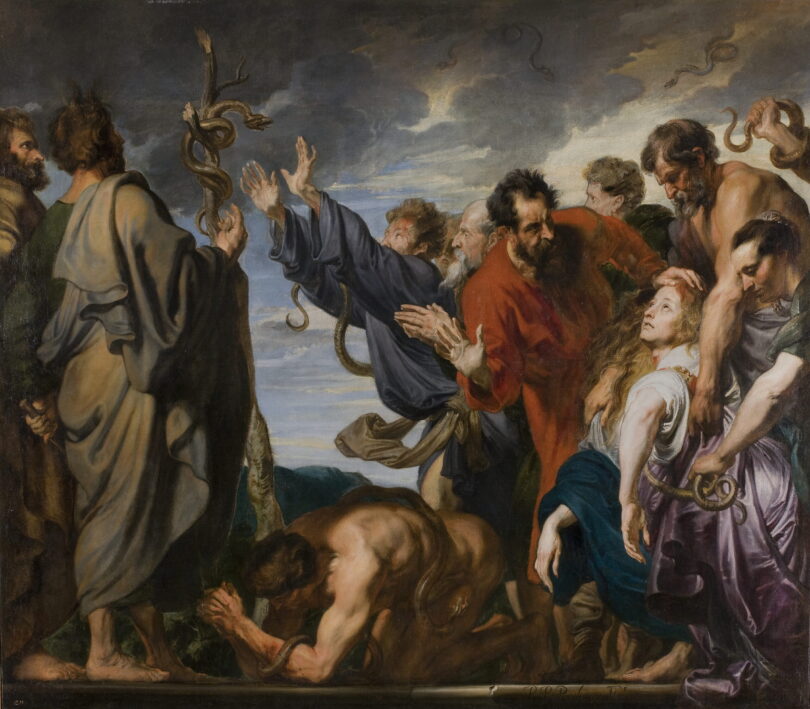
Anthony van Dyck: The Brazen Serpent (Large image at the Museo del Prado)
• First Reading: Genesis 12: 1-4a (God’s call to Abram)
• Epistle: Romans 4: 1–5, 13–17 (The promise comes by faith, so that it may be by grace)
• Gospel: John 3: 1–17 (Just as Moses lifted up the snake in the wilderness, so the Son of Man must be lifted up)
We all remember those special days when we received our pay slips. We were pleased to receive the salary but complained at the cost of the Income Tax deductions, not to mention National Insurance.
But this was a salary and if there was a dispute then there were courts where we could raise a case against our employers, who would also have to answer to the same court or tribunal.
But with God, there is no higher tribunal. If there were then He would not be God. As it is we receive at His hand the blessings that He chooses to bestow and in the way that He bestows them.
Likewise with Abram to whom God made His promises: to bless him and those who bless him and to curse those who cursed him.
And so Abram went forth, aged about 75, following the promises and guidance of God. It was that trust in God that made him acceptable to God.
So Abram was justified by faith and not by works. He believed and this was counted as righteousness. This was long before the law of Israel had been given or even the ten commandments. What counted before God was a personal faith – a direct and personal relationship.
For this the law would never be a substitute even if as we read in Psalm 19, it leads into a deeper and more personal commitment. In this sense there was never anything wrong with the law – but it could, in any land and with any people, be manipulated and abused to oppress and subjugate others.
So to one who works, wages are given as a right – but to one who trusts in God, it is faith that counts: direct, personal and intimate. The promise was never given through the law.
Looking at Jesus and Nicodemus, there are several aspects to look at. Nicodemus was a teacher of the law – but was impressed by the things that Jesus had done and which were there to be seen.
And so Jesus made a number of statements, starting with “You must be born again” and Nicodemus did not question the matter of being born again because in Jewish thought you were born again several times: at the coming of age, upon marriage and the birth of the first son; on being chosen to be a teacher in the high council. But how so when one is old? This was something new.
But Jesus insisted: this was a new kind of beginning with new perspectives and priorities. New relationships and attitudes and all starting with faith in Jesus Himself – and no there was no other way.
How so? Well, Flesh gives birth to flesh and the spirit gives birth to the spirit. This kind of being born again is supremely in the spiritual realm. In is personal and unforgettable, intimate and all-embracing. But what comes from the earth is earthly while what comes from heaven in heavenly, and the differences are critical.
If you do not understand earthly things, how will you understand heavenly things? If you cannot follow a simple explanation based on the experiences and understandings of this world, how can you expect to cope with things that are given in respect of the next?
So here is a clue: As Moses lifted up the serpent in the wilderness, so the son of man must be lifted up. Just as Moses had made an image of a snake, a figure of curse and of sin so that anyone bitten by a serpent in the camp could look at it and be healed, so the Son of Man would also become that image of sin so that being lifted on the cross, anyone who looks to Jesus for salvation and forgiveness would find it.
God so loved the world that He gave His Son so that whoever believes in Him may not perish but have everlasting life.
The extravagance and exuberance of God’s love was so extreme and all-embracing that He gave the best that He had so that the world as a whole need not be separated from Him by its sin but could also look for and hope in the work of salvation that God was already planning.
This was never to be an exercise in condemnation. It was always a matter of forgiveness and reconciliation. In seeing the sin of the human race, God would look upon the condemnation of Jesus and His broken body and spilled blood when people from any land or time put their trust in His salvation.
Instead of each person in the world facing a just judgment for their sins, they would only have to look at and to trust in Jesus. God was never going to desire a regime of condemnation when He could fashion in Jesus a regime of forgiveness and renewal.
This was the whole purpose of Jesus’ life in the world, climaxing in His death on the cross. But equally, that purpose would be fulfilled for each soul who personally looked to Jesus for their salvation.
And then, though flesh might give birth to flesh, the Spirit of God would indeed bring new life to the soul who looks to Jesus, trusting in Him before they ever trusted in themselves.
