Sermon by Rev Sydney Maitland for Sunday 18 February 2024.
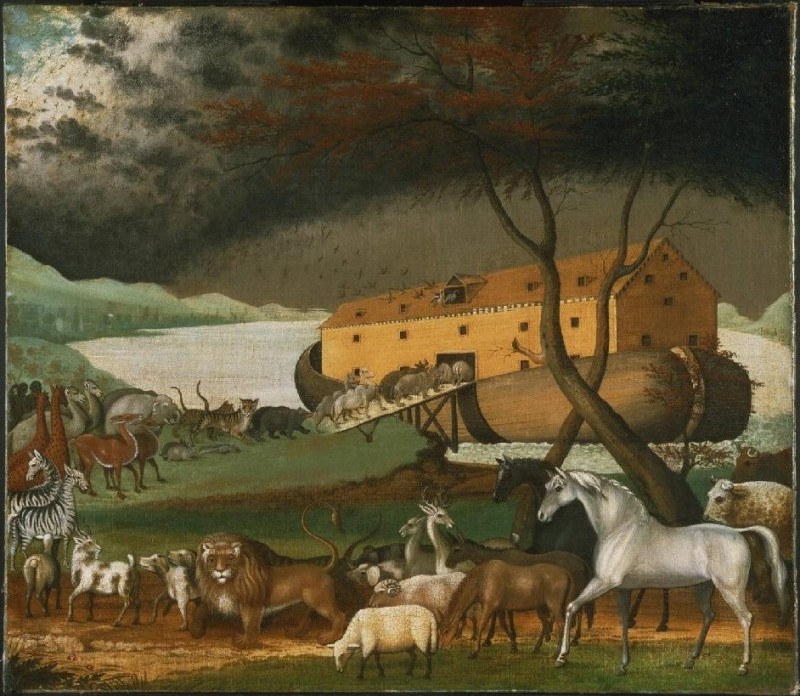
Noah’s Ark (1846), a painting by the American folk painter Edward Hicks
• First Reading: Genesis 9: 8-17 (God’s covenant with Noah. The rainbow as a sign of this covenant)
• Epistle: 1 Peter 3: 18-22 (Christ suffered once for sins – to bring us to God)
• Gospel: Mark 1: 9-15 (Jesus proclaimed the good news: ‘The Kingdom of God is near – repent and believe the good news’)
I think that we all find times to start again. It could be the New Year, or when things start up again after the summer holidays. Then there are birthdays and special anniversaries. These are all times when we look back in order to look forward.
Our elections also offer ways of starting anew, and there are the various sporting seasons as well.
For Noah, the receding flood and the exit from the ark was definitely a time to start again and he worshipped God and received a special kind of covenant from Him, expressed by the 7-colour rainbow (there are others, pointing to different things). This covenant was established by God with all life on earth, and had the promise that never again would the world be inundated by water to destroy land-based life.
Even if we humans have contrived our own means of destroying it anyway – but that is a different story.
But Noah was receiving the opportunity to start again. Build new families and settlements. Establish a new order of life. A new ‘Year Zero’.
Others have offered their own ‘Year Zeros’ – the French Revolutionaries and Pol Pot’s Cambodian Khmer Rouges, but these did not end well.
Part of the problem is that we all have our own ideas about the ideal state system. And they are all different so we have to negotiate with one another on them. Hence our elections – not perfect but an improvement on what else is on offer in other lands.
But then Jesus came, with a simple but clear call.
First there was an announcement: ‘The Kingdom of God is near.’
The rule of God – His priorities and His means. His ways of expressing them and His ordering of our relationships, first of all with Him and then with one another.
Out of that can come our politics and economics, our laws and institutions and everything else needed to serve a society.
But then there was a second part: ‘Repent’. Turn aside from what is corrupt and corrosive. Turn aside from what degrades and destroys.
Look for new priorities and loyalties. There is a new set of principles to live with and in, and they all start in the heart. They are not imposed but live in our deepest motivations and memories, our most pressing needs and enduring relationships. They are there in our attitudes and in what make us tick.
These are the things that make us smile and bring joy to the heart, they meet us in the deepest parts of our souls and personalities, and this is where the Kingdom of God must begin to rule.
There is no point in writing new laws and imposing new taxes if they are founded on the same set of resentments and anxieties as the old regime.
There is no point in erecting new buildings, and building new cities if all that happens is the same set of self-consuming and corrupting impulses that reigned before.
But then Jesus’ third word was a summons to faith: ‘Believe the good news.’
People believe in all sorts of things and in believing they then place their highest loyalties in them. It could be art or sport, politics or the getting and spending of money.
It could be science, or the pursuit of knowledge and understanding.
It could be relationships in the family or community.
Jesus’ call was to believe the gospel – the message of forgiveness and new life. A new kind of beginning to which all are invited and in which the principles of guilt and condemnation need no longer apply. This is not a blame culture but one founded on hope and trust, and centered first of all on Jesus.
Only after His atonement comes the life of the community of believers – a community of faith rather than the structures of the church.
It is not as if the gospel is about the destruction or replacement of other aspects of life. The business of government and of trade still continue, but based on different foundations. We all know what happens when the foundations for government and trade stand on degraded and corrupting impulses.
And this brings me back to Jesus. Just as Noah’s world soon enough descended into violence and self-seeking, so the gospel of Jesus, and its institutions must remain firmly centered on Him.
This is where we find forgiveness and new life. It is where our relationships and loyalties, our impulses and memories are given a new start and a new power for the future.
To say that this is without cost or consequence is facile – but then Jesus’ own message was going to be empowered by His own self-giving on the cross.
This Lent, as we look at His cross then so we can make a better sense of the things that hold us back – especially the things that do not have to.
