Sermon by Rev Sydney Maitland for Sunday 5 February 2023.
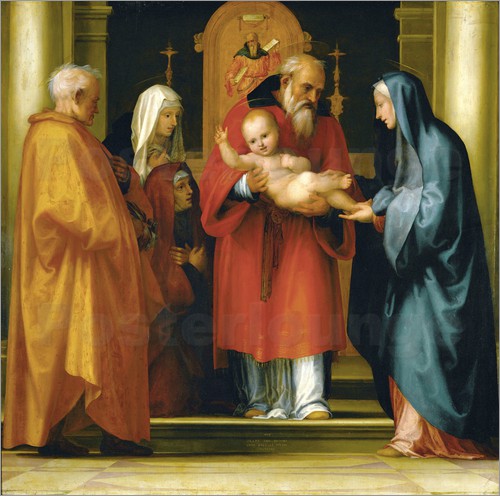
Fra Bartolomeo (1472-1517): Presentation of Christ in the Temple (Source)
• First Reading: Malachi 3: 1–5 (I will send My messenger, who will prepare the way before Me)
• Epistle: Hebrews 2: 14–18 (He shared in their humanity so that by His death He might break the power of him who holds the power of death)
• Gospel: Luke 2: 22–40 (Jesus presented to the Lord – the sacrifice of two doves or pigeons)
Anyone who has had children will know the pride of having the baby to show to family and friends. Pictures are passed around and there are the regular reports of how he or she is growing, crawling, walking and speaking.
Progress in school is marked with careful attention and the issues of pre-school childcare, the cost of clothing and life in the new form of household are all part of the picture.
When we look at Jesus there was a similar process going on. He was circumcised on the eighth day as a sign of His membership of the Jewish nation and people. On the 40th day He was presented to the Lord – shown off to God in a ceremony in the temple.
This was marked by the sacrifice of two birds – doves or pigeons – as a sign of the parents’ serious intent. This was more than the proud parents showing off their baby to the world. It was also a mark of their intent to raise Him as a faithful member of the Jewish community, including its religious laws and rituals.
Perhaps our best parallel is in the baptism of infants when we expect the parents and godparents to make a public declaration of their faith and their intention also to see that the baby is raised within the Christian faith to that he or she can eventually own the promises made at baptism by godparents.
But the Presentation of Jesus is more than a formal act of bringing Him before God in the temple of Jerusalem. It was also a mark of a deeper and lifelong commitment to His identity as a Jew.
This is one of a nation rescued from slavery, whose first patriarch had been called to an unknown and unknowable future, defined and expanded by the extravagant promises of God, for himself and through him, for the whole human race.
Now Jesus would become the centre of the whole of human history, balancing tens of thousands of years of human development with maybe a few dozen centuries of trade and technology.
And Jesus would be, not only at the centre of this human history – He would be that very centre Himself. Nothing less – for He would be personally immersed in the full economy of God and His plans for the whole of humanity.
All this being within the simple rite of being presented to God in the temple on the 40th day.
His ministry, climaxing on the cross, would be many years in the future and yet the promise of it was already active as God drew Simeon to join Mary, Joseph and Jesus.
Simeon evidently believed in life beyond death for he looked to God, thanking Him for the fulfilment of a promise that he would see the Messiah before he died and yet now content to die and to enter that place that God had prepared for him.
This was a man at peace, in praise and worship of God, grateful for what had been fulfilled for him and now ready for the next steps. No fear of death here.
Our lessons from Hebrews and Malachi gives us a much wider context to think about.
Malachi looks towards a Messiah who would bring judgment – on the nation of Israel, never mind the rest of the world, including the church.
God would visit His people with a critical eye. He would come to purify His servants and to judge their works. Had the nation of His covenant been faithful to it? Had they been faithful to God – and had they been faithful in His name, to one another in all relationships and transactions?
Such a visitation today would indeed bring some anxiety especially as we learn of the jack-boot tactics of some debt collection agencies, apparently acting within the law.
Would such a Messiah really be the answer to our politicians’ hopes – or would they rather hope that it will never happen – at least, not in their lifetimes?
The sense of vindication of the powerless in the face of the powerful is palpable – yet it is too glib to reserve such judgment on the mega-rich when print and social media campaigns are so easily raised up by anyone and against those who have no real hope of reply or redress.
But then there is the hope expressed in the letter to the Hebrews. Jesus is seen as being within the centre of humanity. Never succumbing to degrading poverty and yet never overawed by wealth or power, of which He saw plenty.
It is His simple humanity that encourages us to approach in faith and confidence, knowing that whatever we face, He also has seen in its essence, if not with today’s society and technology.
But Jesus came for far more than to help in our temptations. He came to overcome the fear of the fact of death. He came to overrule the condemnations of the simple and poorly-connected by the powerful and to pour our His mercy when others desire only to celebrate our inadequacies.
Jesus came to minister both the holiness and the justice of God and to meet both by placing Himself at the centre of God’s judgment.
And He came to do it with a perfect love – the kind that overrules and banishes fear, so all we need to do is to ask.
