Sermon by Rev Sydney Maitland for Sunday 24 November 2024.
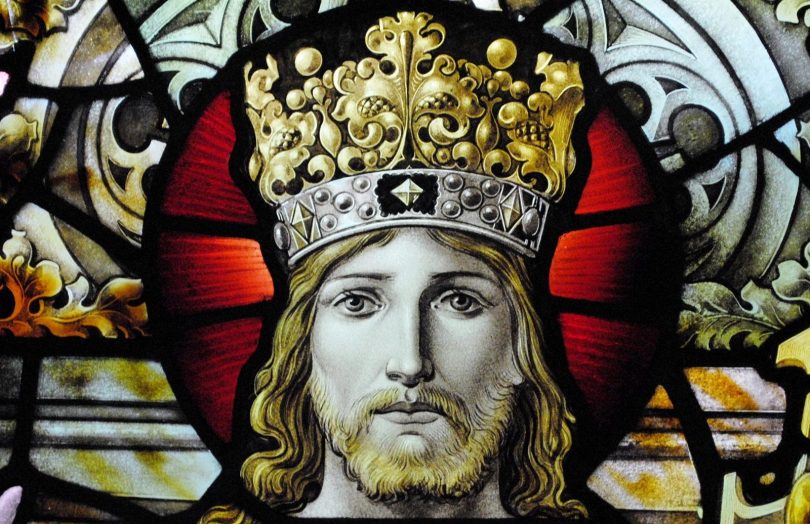
Christ the King in stained glass at All Saints. Photo: Ken McCreadie.
• First Reading: 2 Samuel 23: 1-7 (David’s last words)
• Second Reading: Revelation 1: 4-8 (Greetings and doxology from John to the seven churches in the province of Asia)
• Gospel: John 18: 33-37 (Pilate to Jesus: Are You the King of the Jews?)
I was born a couple of years after our King, so for all of my life, he has been almost a contemporary with me.
I remember the early photographs and reports of him at a London day school, and perhaps a low point for him which he is probably still living down, the famous incident of the cherry brandy, drunk when skipping out from boarding school.
And then all the blues and stews of life, in various armed services and his marriage to the late Princess of Wales.
The late Queen came to the throne in the aftermath of World War II, when the land was very deferential, and then she saw the dissolution of the British Empire and the collapse of deference in any form. Any and every national institution was fair game for criticism and ridicule.
During that time the present King also navigated the turbulence of the times, developing a keen and informed interest in the environment along with an easy style in meeting people and getting on with them.
In this way our monarchy has survived, as have those of Holland and in Scandinavia.
Yet this is a misleading lens through which we look at Jesus as Christ the King.
We are all familiar with His lowly birth and ordinary life as a child and in becoming the village carpenter.
But then the gospels erupt into demonstrations of His personal power and authority.
He could heal the sick: the blind and the deaf and dumb, and the spiritually oppressed; He could raise the dead and with these signs He set forth His authority to forgive sins.
In this way, His work was all in those areas of life that all people see. It was nothing to do with the showy demonstrations of worldly power, such as living in wonderful palaces, wearing gorgeous clothes and eating luxuriously.
Neither was it in the command of armies or the raising of great monuments or construction projects.
Jesus built no temples or fortresses or even aqueducts. He built no roads or bridges, and His ministry to the poor and the sick was on the basis of those whom He met from day to day.
But then power over sickness and death, the authority to forgive sins and even on the cross to promise Paradise to the penitent thief, were of a wholly different order to the powers and authorities of the rulers of the world.
These might wage wars and conquer lands and cities; they might build great edifices but they were not healers of souls and relationships; they might demand fealty but could not grant eternal life.
Upon their deaths they might be laid in great tombs – but that is where they would stay. There would be no resurrection for them: only the prospect of facing the Lord of all Life with their pleas for mercy.
And yet today, we worship Jesus Christ as Lord. We celebrate His death and resurrection, we read of His message and the works of the very early church and those who knew Him face to face.
So when standing before Pilate, He could and did stand upright, looking him in the eye and saying that Yes, He was a king – but a king far beyond Pilate’s imagination or understanding.
His followers would follow in the path that He had already laid out for them, and they also would proclaim the forgiveness of sins; they would heal the sick and raise the dead; they would take authority over the powers of darkness just as He had.
And they would also face persecution and death, just as He was.
All this gives us a different way of looking at Jesus as Christ the King. The reality of His authority is already with us as we believe.
To us that rule and that glory are already revealed, and they set out who we are, where we are going, and what is most important in life.
Yet there are others to whom these things are hidden. The scriptures are a blur and the institution of the church is there to be ridiculed and abused.
They are still trying to reconcile ‘An eye for an eye’ with the King of Love. How can a King rule over poverty and disease? And most annoying of all, why is it that these Christians have this freedom from the fear of death, that makes them so complacent?
Yes, this is the veil of confusion that lies over those for whom Jesus is, as Churchill once said of Russia: an enigma within a riddle within a paradox. (Or something very much like it.)
For us, Jesus is the King who is coming back. He has already taken the blame for the wars and massacres and devastations of history.
Now we wait for Him to return and claim what is His own and to remodel it in His own fashion.
For the difficult bit has already been done: on a hill not far from the Temple Mount and the Roman garrison fortress.
