Sermon by Rev Sydney Maitland for Sunday 15 January 2023.
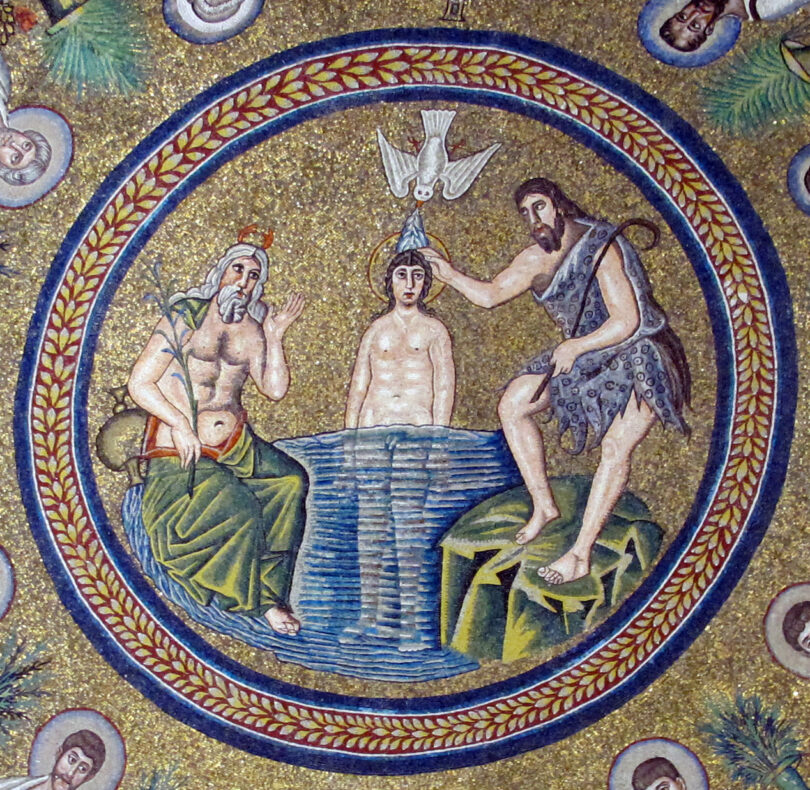
Arian Baptistry, Ravenna, 6th-century/a mosaic. A classical personification of the Jordan attends at left. (Source)
• First Reading: Isaiah 42: 1–9 (I will put My spirit on Him and He will bring justice to the nations)
• Epistle: Acts 10: 34–43 (The work of Jesus – the witness of His disciples. Jesus’ death and resurrection)
• Gospel: Matthew 3: 13–17 (Jesus baptized by John – to fulfill all righteousness)
It used to be the case that when starting one’s first job, to be given all the menial and tedious tasks of the office, shop or workshop. It could be being sent off on some rather pointless errands or just providing a kind of dogs-body role for anyone who did not want to do that particular job for oneself.
But there was always the expectation of moving on to higher things – making decisions, presenting reports, holding meetings.
For Jesus however, He was starting as He always intended to continue – not only by making Himself one with all in Israel who desired to repent of sins and of dead works, dead attitudes or dead relationships.
He was starting where He expected to continue – in making Himself one with those who thought least about themselves and who had no thought of self-promotion. These were the social, moral and professional no-hopers, the failures in life, those for whom life never had and was never going to produce first prize.
These were the survivors of society – those who just about got by and on whom it was most convenient for the rulers and opinion-setters to dump their own prejudices and moral indignation. They would be most acceptable scapegoats for dumping the inadequacies of the high and mighty, and these little ones would never get the opportunity to speak out for themselves.
And yet it was precisely these people to whom Jesus had come to proclaim the kingdom of God: ‘Repent and believe’. There is nothing to lose and everything to gain.
And so Jesus stepped out of His own standing – Son of David, a man skilled in His own craft as a carpenter-builder, One who knew the law and could converse on it very comfortably.
Now, Jesus was starting His real work in life – and He was doing it by a monumental act of self-emptying.
He would live that sinless life in the place where the temptations to compromise would be greatest. He would face up to the pressures to conform, to join in the abuse of the defenseless, to make all those moral and intellectual short-cuts that make life that little bit more liveable.
This would continue throughout His ministry and come to its climax on the cross, when not only would He be wholly emptied of all claims of self, but He would then take on Himself the sins and compromises and corruptions of everybody else instead.
But this is where the irony becomes that much more pressing for this was the very point when Jesus was both publicly acclaimed by the audible voice of God but He was also endowed with the fulness of the Holy Spirit.
It was when Jesus had been most pointed in self-emptying that He was the most fully validated by God Himself.
God was bringing honour to One who in the conventional sense had no preparation or credentials for the work of proclaiming the Kingdom of God.
In being sinless Jesus would be able to forgive the sins of others, and yet in being human He would see and know the impulses that led people into sin.
In being that perfect Lamb of God, without spot or blemish, Jesus would be able to bring wholeness of body and mind and spirit to those who were broken of heart or of body or of mind. He would see far more than others the nature and ravages of sickness of body when He came upon it.
His own perfect body would give Him the perfect place to repel leprosy or any other sickness that drove people from the comforts of society.
Equally He would see the intellectual corruptions of the purposes of God shown by the law of Moses that would be perpetrated by the rulers of the time. And He would have plenty to say about them as well.
The self-emptying of Jesus was necessary to fulfill all righteousness in the sight of God. His message of salvation and the forgiveness of sins, would be about forming real spiritual lives in which God was the starting point and the focus from them on.
Perhaps that is a contrast with today. The disciples who followed Him were not going to form a community spirituality circle in which members could pick and choose that which was to their taste and avoid the uncongenial.
Rather, they were going to be led into a place of personal commitment where they would learn from Jesus what self-giving and self-emptying were all about. They would learn about it, as it were, in the field of day-to-day human contacts and issues.
For us the challenge is also to follow Jesus into that place of self-emptying in order that God might meet us and also fill us with His spirit.
He would lead us into all truth – not our personal pluriform truths but His all-engaging truth. He would lead us to that place of fellowship with Him and with one another where a new kind of freedom prevails.
He would lead us into that place where we also are empowered to continue in the task that He passed on to His disciples: no longer in the place of learning but entrusted with the work of teaching – and teaching the alienated and distressed the truth of Jesus Christ and Him crucified.
