Sermon by Rev Sydney Maitland for Sunday 22 December 2024.
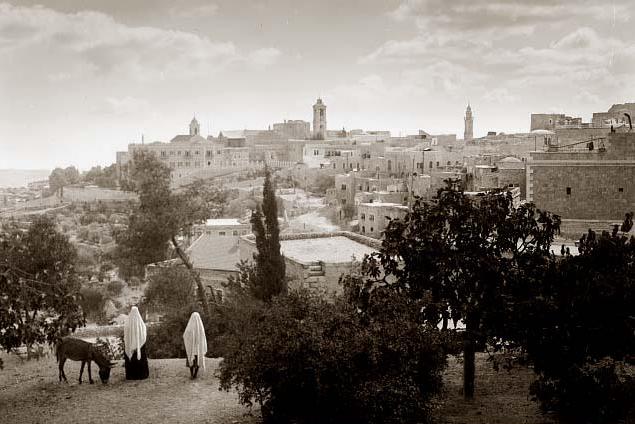
View of Bethlehem, Christmas Day 1898 (Source and background story)
• First Reading: Micah 5: 2-5 ()
• Epistle: Hebrews 10: 5-10 ()
• Gospel: Luke 1: 39-55 ()
Have you noticed how much of our public discourse is more about performance and presentation – rather than content or meaning?
Look at any discussion about any major topic – and the first thing to come up is what it looks like and feels like. The presenters, and what they look like. Do their age/sex and racial and social profile contribute to what is said – or do that take away from it?
And then after that, it is again not about content and its coherence, buy who gains and who loses from it? Again the nature of the discussion take second place to the atmospherics.
This is definitely so at election time – but it applies to practically any other matter of discussion as well.
Now look at Micah.
Bethlehem is essentially a suburb of Jerusalem. About five miles to the south. No great market places or fortresses or palaces. Tragically it is now separated from Jerusalem by a big security wall, erected to meet the character of today’s relationships.
But Bethlehem did not have that much going for it. Not like Hebron, the former capital of Judah. But this is the town that is given comfort and encouragement by the Prophet Micah. While not greatly endowed by nature or for its resources, God has chosen it for a great and a lasting heritage.
Bethlehem would remembered when greater towns and fortresses have been reduced to rubble and footnotes in books on archaeology.
It might be a staging post for invading armies over 3000 years, but God knows its name and its importance.
And the promises is of One to come who would rescue His people and rule then justly. A shepherd to the whole flock, and not just a dictator for the 51% who provide political support, thrown up by an electoral system where the winner takes all the loser has to hope for a better fortune next time.
One to whom the wounds and sores of all members of the community are taken personally: the in-crowd and the out-crowd as well. Those who are fashionable and strong, and those who are unprepossessing and who do not know how to express their thoughts and feelings to those in authority.
This brings us very close to Mary and her song of joy when she met her cousin Elizabeth, also with child following a promise from God.
She too looks for One to deliver the people. To raise up the downtrodden and the voiceless, in the face of the wealthy, the strong and the well-connected.
While the natural order of society may favour the most capable and the most accomplished, even the greatest business needs people to buy its products; even the general needs soldiers on the front line; even the statesman needs taxpayers and an overall adherence to the law of the land.
So yes, Mary was looking to a new kind of order. And this is still an order – it is not a disorder or an anarchy. Nobody today is seriously proposing a social order without water supplies and sewers; without electrical and data connections.
But the celebration of Mary and the promise of Micah are not vested in a new system of social or economic order.
They are both looking to One anointed by God – a Messiah. One who is directly and personally of God and in God and yet who is also wholly human.
This is one who will rule and who will judge. Make choices, allocate resources, settle disputes, determine borders.
And this is a rule founded on the love and mercy and justice of God. Impartial and yet wholly compassionate.
But the writer to the Hebrews gives it all a further twist. Not a distortion but a development.
Nothing is being invented, but what was already there is being given new voice and expression.
This is the sense of personal vocation.
First of all, it is the Messiah Himself – Jesus Christ. The suffering servant who has defeated death and risen from the tomb.
This is the one whose life, death and teaching reach into the hearts and lives of all who follow Him. A light to penetrate the deepest personal obscurity and murk, a voice that rings clear for the dullest of hearing.
What He said to the Lord, ‘Here I am: I have come do your will’ He has also invited us to say the same thing to Him.
This is a rule and a governing principle operating in the depths of our hears and in the deepest of our motives and ambitions.
It is a principle of life, vibrant in the remotest parts of our souls. It is founded on the sacrifice that Jesus has already made and which needs no repetition. Only that we should remember and honour it from the depths of who and what we are.
So yes, there is a new ordering of society – springing from His utter and total self-giving.
And Mary had good reason to say, ‘Tell out my soul, the glory of the Lord.’

