Sermon by Rev Sydney Maitland for Sunday 11 December 2022.
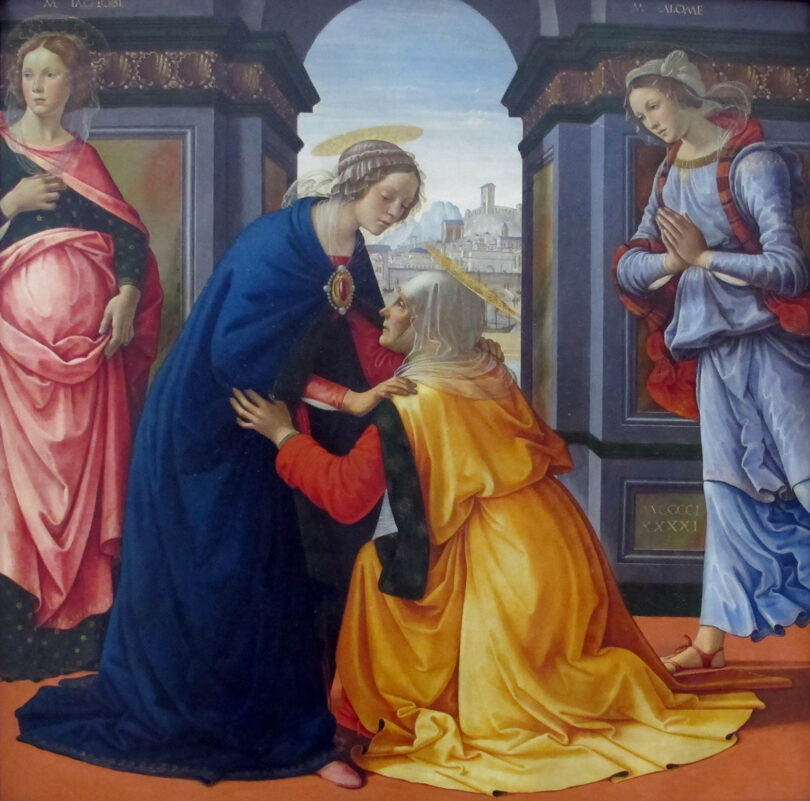
Visitation, by Domenico Ghirlandaio (1491), depicts Mary visiting her elderly cousin Elizabeth. (Source)
• First Reading: Isaiah 35: 1-10 (Joy of the redeemed)
• Magnificat: Luke 1: 46b-55
• Epistle: James 5: 7-10 (Be patient until the Lord’s coming. Be patient and stand firm. Don’t grumble against one another)
• Gospel: Matthew 11: 2-11 (John: the greatest of all born of woman – but the least in heaven is greater than he)
The news headlines do not look good. Strikes in much of the public sector, war in Eastern Europe, global warming, drought and starvation, and this is before we even begin counting the social, commercial and environmental flashpoints around the world.
For many, the answers must lie in science and politics. If people will not comply with the needs of the time then they must be forced. And although implied but not said out loud, if inflation and mortality increase then so be it.
This is perhaps a counsel of despair. It relies on the same human, moral frailty that let these things happen in the first place, and how can scientific and political decisions founded on funding and let by expediency be expected to lead to just and equitable solutions?
And for many the Christian hope, called by some ‘pie in the sky when you die’ is simple escapism and self-delusion.
But then there is another way of seeing things. We live in an ordered creation in which the forces of nature are ordered and predictable to that science may be invoked to study and understand them and so that solutions to human needs may be found.
It is a created order in which the very fact that our bodies are largely the same means that we can eat, drink, communicate and reproduce in an ordered environment.
What is not ordered is our individualized moral reasoning. That applies to all relationships, including and especially those of politicians.
But God did not create an ordered world so that it may dissolve itself in moral chaos. In the midst of difficult personal issues many years ago I found myself concluding that I could not believe that it was all wholly random and that there was not a purpose and an intelligence behind it all. It was only that I could not understand them at that time.
My ignorance in these things did not mean that they did not exist – any more than that the astronomers of ancient Egypt could not have probed the validity of Newtonian and Einstein’s physics.
Rather, the response has been to trust in the providence of God even when I did not have the whole picture or vision.
Yet what we are given is a vision of what God intends for His people and for the earth.
It is a vision of a world living and thriving within God’s provision and according to His purposes. A vision of plenty and not want; of peace and not conflict. Where misunderstandings do not have to lead to dispute or war.
This is not just a place of environmental balance but of peace and harmony in society as a whole and in the spiritual realm in particular. It is a place where relationships start with God and where He is not an afterthought in times of trouble.
It brings me to what Jesus had to say to the messengers of John the Baptist.
The question was ‘Are You the One foretold?’ and Jesus refused a direct answer. In some ways it was the same answer that Jesus gave to Pontius Pilate.
So Jesus refused a direct answer which could have been taken as an assertion or declaration.
What He did was to turn the question back to John’s disciples. ‘What do you think? What do you see and hear? How do you receive the miracles of the blind receiving their sight, the deaf hearing and the lame walking? What about the lepers cleansed and the sinners restored to relationship with and love for God?’
Now He was making them into evangelists using their own observations. Not as journalists dispassionately reporting events.
What did they see? What did they understand? How was it going to affect them? Would it affect them at all or would they see something more, something beyond everything that they had known before?
So what about us? Will we allow the skeptical but bruised world to see only our hope for ‘pie in the sky when we die’ or will there be something more, something electric in the nature of our relationships and loyalties and attitudes? Will it be seen in our priorities and commitments?
Will it be there as we gather in praise and worship and as we make our requests known to God?
In His letter to the church, James urges them to be patient – but not to lie down on the job. To stand firm and not to be swayed by every fashion and fantasy in the public arena.
To stand firm on what we know without being arrogant or conceited. To maintain our sense of loyalty and identity without degenerating into bigotry. To love the sinner without underwriting the sin.
As we gather in worship we are doing far more than having a social bonding session. We are also being taken up with the things of God.
It is a new and greater dimension, where the summit of God’s love is shown by the summit of His sacrifice – what started in a manger in Bethlehem climaxed on a low hill outside Jerusalem just a few miles away.
